 Get That Shape AI
Home › Blog › Progressive Overload: The Only Rule That Guarantees Progress
Progressive Overload: The Only Rule That Guarantees Progress
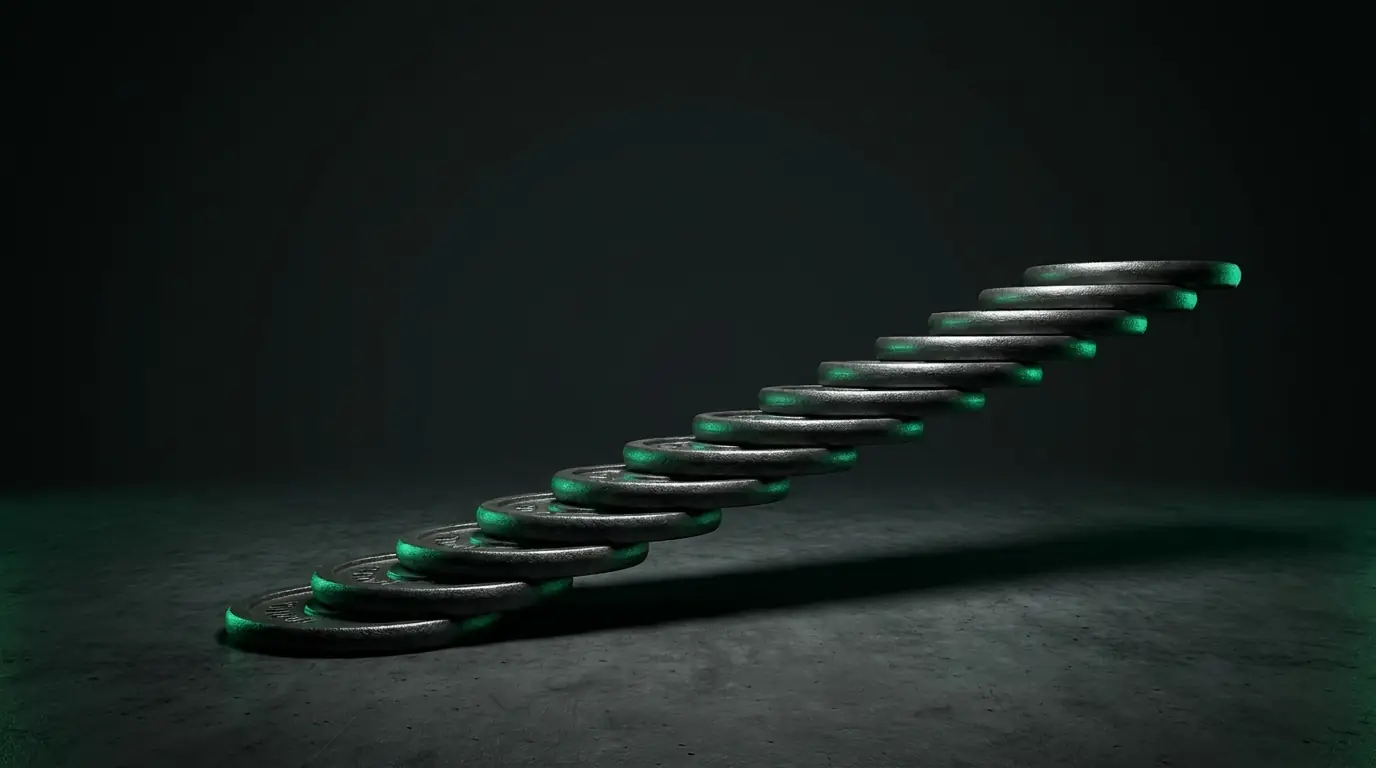
Almost every training question has a debatable answer. This one doesn't: if the demand on your muscles never increases, they have no reason to change. Progressive overload is the rule underneath every program that has ever worked — here's what it means and the five ways to apply it.
What progressive overload actually is
Your body adapts to what you repeatedly ask of it, and it adapts only as far as it needs to. Lift a given weight for a few weeks and your muscles build exactly enough capacity to handle it comfortably. Then they stop, because there's no longer a problem to solve.
Progressive overload is the deliberate practice of giving them a new problem: doing slightly more than last time. Not dramatically more — slightly. That's the entire mechanism behind getting bigger and stronger, and everything else in training is a detail on top of it.
It's also the reason the person doing the same three sets of ten with the same 12kg dumbbells since January looks the same as they did in January.
The five ways to overload
Adding weight is the most obvious method, but it's only one of five. When one is unavailable, another usually is.
- 1. More weight — the classic. Same sets and reps, heavier load.
- 2. More reps — same weight, more repetitions. Go from 3 × 8 to 3 × 12 before adding load.
- 3. More sets — a fourth working set adds real volume, which drives growth.
- 4. Better quality — deeper range of motion, stricter form, no bounce or swing. The same number on the bar becomes a bigger stimulus.
- 5. Less rest — the same work in less time raises the density of the session.
Tempo belongs in the fourth category and deserves a mention of its own: taking three seconds to lower a weight, or pausing two seconds at the hardest point, makes a load you've mastered feel new again.
The practical method: double progression
Most people do best with a simple system called double progression. You work within a rep range instead of a fixed number.
Take dumbbell bench press with a target of 3 sets of 8–12:
- Week 1 — 20kg for 8, 8, 7. You're at the bottom of the range, so stay here.
- Week 2 — 20kg for 10, 9, 8. Progress, same weight.
- Week 3 — 20kg for 12, 11, 10. Nearly there.
- Week 4 — 20kg for 12, 12, 12. Top of the range on every set — now add weight.
- Week 5 — 22.5kg for 9, 8, 8. Back to the bottom of the range, and the cycle repeats.
This works because it never asks for a jump you aren't ready for, and it removes the guesswork about when to increase load. The rule is simple: hit the top of the range on all sets, then go up.
How fast should you add weight?
Slower than you want to. Sensible increases:
- Lower-body lifts — 2.5–5kg at a time.
- Upper-body lifts — 1–2.5kg at a time. Small muscles progress in small steps.
- Beginners — can often add something almost every session for the first few months. Enjoy it; it doesn't last.
- After the first year — adding load monthly is good going. Progress becomes a slower, longer game.
If your form breaks down when you add weight, the jump was too big. Go back and add reps instead.
Why you must write it down
Progressive overload requires knowing exactly what you did last time. Not roughly — exactly. Nobody remembers whether it was 9 or 11 reps on the second set three weeks ago, and that's precisely the number that tells you what to do today.
A logbook turns training from a series of disconnected workouts into a continuous progression. If you take one thing from this article: record every set — weight and reps. It's the highest-return habit in all of training.
When progress stops
Every linear run ends. When you stall for two or three sessions on the same lift, don't just keep grinding into it:
- Switch the overload variable — if weight won't move, chase reps, sets or tempo instead.
- Take a deload week — cut the load by around 40% for a week. Accumulated fatigue is often hiding strength you already have.
- Check recovery first — sleep, food and rest days stall more lifts than programming ever does.
- Change the variation — swap flat press for incline for six weeks, then come back. You'll usually return stronger.
Stalling on one exercise is normal. Stalling on everything at once is a recovery problem, not a training one.
Overload without a fully equipped gym
Limited equipment doesn't exempt you from the rule, it just changes which lever you pull. With one pair of dumbbells you can still add reps, add sets, slow the tempo, pause at the bottom, shorten rest, or move to a harder variation — a two-leg squat becomes a split squat, a press becomes a feet-elevated press. See the dumbbell-only plan for how this looks in practice.
The mistakes that quietly cancel it out
- Adding weight but cutting depth — a heavier half-rep is not progress, it's a shorter rep.
- Chasing soreness instead of numbers — soreness measures novelty, not progress. New exercises make you sore; they don't necessarily make you bigger.
- Changing program every month — you can't overload a lift you stopped doing.
- Adding load and reps and sets at once — you'll overshoot recovery and won't know what caused the stall.
- Ignoring the last set — the sets closest to failure carry most of the stimulus.
How long does this keep working?
Longer than you'd expect, but not forever at the same rate. A beginner can add weight nearly every session for months. An intermediate progresses week to week. An advanced lifter might add a few kilos to a lift across a whole training block — and that's still progress.
The rate slows; the principle never changes. Ten years in, the answer to "how do I get stronger?" is still: do slightly more than last time, and recover well enough to repeat it.
Overload is simple in theory and easy to lose track of in practice, because it depends on remembering what you lifted and deciding what comes next. That's precisely the part an AI trainer handles — it reads your logged sets, sees which lifts are ready to move up and which need another week, and writes next week's targets for you. More on why progress stalls.
Skip the guesswork
Get That Shape AI builds a plan around your goals, equipment and progress — and adapts it every week.
Get the app