 Get That Shape AI
Home › Blog › How Much Protein Do You Actually Need to Build Muscle?
How Much Protein Do You Actually Need to Build Muscle?
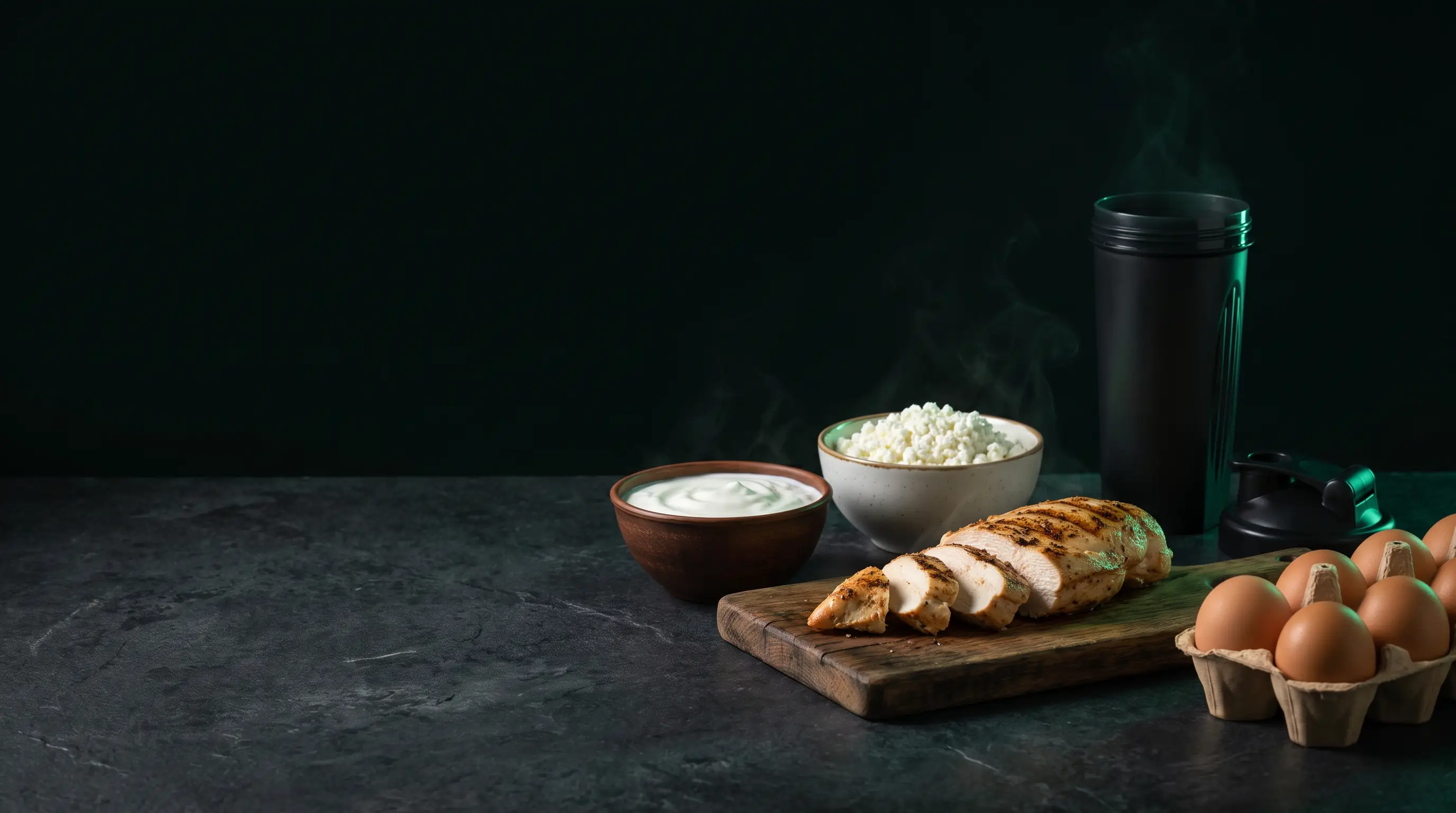
Protein is the one nutrition variable worth being precise about when you're training for muscle. Not because it's magic, but because it's the easiest one to get wrong in both directions — most people eat too little, and a smaller group eats far more than does anything. Here is the number, where it comes from, and how to actually hit it.
The short answer
- 1.6 g per kg of bodyweight per day is the point where the benefit for muscle growth flattens out in the research. That's roughly 0.7 g per pound.
- 2.2 g per kg is a sensible upper bound. Between 1.6 and 2.2 you're buying a small margin of safety, not a meaningfully better result.
- Above 2.2 g per kg there is no measured additional muscle. It isn't harmful for healthy people, it's just expensive and filling.
If you want one number to aim at and never think about again: 1.8 g per kg. It sits comfortably inside the useful band, absorbs a bad day or two, and doesn't require you to plan your life around chicken.
Work out your own number
Multiply your bodyweight in kilos by 1.8. That's it. To save you the arithmetic:
- 60 kg (132 lb) — about 110 g per day
- 70 kg (154 lb) — about 125 g per day
- 80 kg (176 lb) — about 145 g per day
- 90 kg (198 lb) — about 160 g per day
- 100 kg (220 lb) — about 180 g per day
If you're carrying a lot of fat, use your target bodyweight rather than your current one — muscle tissue is what needs feeding, and scaling protein to fat mass just inflates the number for no reason. A 120 kg person aiming for 95 kg should eat for 95 kg.
What that looks like in real food
Numbers in grams are abstract until you map them onto things you actually put on a plate. Rough protein content per typical portion:
- Chicken breast, 150 g cooked — about 45 g
- Lean beef or pork, 150 g cooked — about 40 g
- Salmon, 150 g — about 38 g
- Tin of tuna, drained — about 25 g
- Greek yogurt, 200 g — about 20 g
- Cottage cheese, 200 g — about 24 g
- Three whole eggs — about 19 g
- Whey shake, one scoop — about 24 g
- Lentils, 200 g cooked — about 18 g
- Firm tofu, 200 g — about 32 g
- Skimmed milk, 500 ml — about 17 g
Look at that list and the target stops feeling extreme. A 145 g day is eggs at breakfast, a tin of tuna and yogurt at lunch, chicken at dinner, and a shake somewhere. Four decisions, not a spreadsheet.
Spread it across the day
Total daily protein does most of the work, but distribution has a measurable second-order effect. Muscle protein synthesis responds to a dose, and the response saturates — so four servings of 35 g beat one enormous 140 g dinner.
- Aim for 0.4 g per kg per meal, three to five times a day. For an 80 kg lifter that's roughly 30–35 g a sitting.
- Don't skip breakfast protein. It's the meal where most people eat almost none, and it's the easiest 25 g to add.
- The pre-sleep meal is genuinely useful — 30–40 g of a slow-digesting source such as cottage cheese, Greek yogurt or casein before bed measurably supports overnight recovery.
The anabolic window is much wider than you were told
The rule that you must drink a shake within 30 minutes of your last set is one of the most durable myths in the gym. What matters is total intake across the day and the hours around training — a window of several hours, not minutes. If you ate a proper meal two hours before lifting, you're covered. Sprinting to the changing room is not the variable holding back your progress.
Cutting changes the number
When you're in a calorie deficit, protein does double duty: it feeds growth and it protects the muscle you already have from being burned alongside the fat. Two adjustments:
- Go higher — 2.0 to 2.4 g per kg. The leaner you are and the steeper the deficit, the more this matters.
- Keep training heavy. Protein alone doesn't tell your body to keep the muscle; the training stimulus does. Cutting calories while also cutting your weights is how people end up smaller but not leaner.
Protein is also the most satiating macronutrient by a wide margin, which quietly makes the deficit easier to hold. That is half of why higher-protein diets outperform in practice.
If you eat plant-based
Entirely workable, with two adjustments. Plant proteins are generally lower in leucine — the amino acid that most strongly triggers the growth signal — and less completely digested.
- Add roughly 10–20% to your target, so 2.0 g per kg rather than 1.8.
- Combine sources across the day — legumes with grains, soy, seitan, pea protein — so the amino acid profile fills in.
- Lean on the dense options. Tofu, tempeh, seitan, lentils and a pea or soy isolate do the heavy lifting; nuts and vegetables contribute far less than people assume.
Common mistakes that waste the effort
- Counting the protein you meant to eat. Weigh food for one honest week. Almost everyone discovers they're 30–40 g short of what they estimated.
- Treating shakes as the plan. A shake is a convenient 25 g when real food isn't practical. It is not a strategy, and it isn't better than food.
- Ignoring total calories. Perfect protein inside a large calorie deficit still won't build much. Growth needs material and energy.
- Chasing exotic supplements. After protein and calories, the list of supplements with strong evidence for muscle is short and boring — creatine monohydrate, and that's more or less it.
- Assuming more is better. Eating 3 g per kg costs money and appetite and buys nothing measurable. For people with healthy kidneys it isn't dangerous, but it isn't useful either.
Protein is not the bottleneck for most people
Here's the uncomfortable part. If your training has no structure and your loads never change, fixing your protein will do very little. Nutrition supports adaptation; it doesn't cause it. The signal to grow comes from progressively harder training, and the food is what lets you answer that signal. Get both right and the timeline is roughly what you'd expect — see how long it actually takes to build visible muscle. Get only the food right and you'll be well-fed and the same size.
So the honest priority order is: train consistently, add load over time, sleep, then hit your protein, then worry about anything else. If you've been stuck despite doing all of this, the problem is usually further up the list — here's how to diagnose it.
Three days that hit the target without thinking
If planning is the part that defeats you, steal one of these. Each lands between 140 and 155 g.
- The office day — three eggs and a coffee (19 g), Greek yogurt mid-morning (20 g), a chicken and rice bowl at lunch (45 g), a shake in the afternoon (24 g), salmon and potatoes at dinner (38 g). Total: 146 g.
- The lazy day — protein oats made with milk (30 g), tin of tuna on toast (28 g), a big cottage cheese bowl (24 g), and a 200 g portion of mince with pasta (45 g). Total: 127 g, plus one shake gets you to 151 g.
- The plant-based day — soy yogurt with a scoop of pea protein (30 g), a lentil and grain bowl (28 g), tempeh stir-fry (32 g), tofu scramble (32 g), plus milk alternative and bread through the day (15 g). Total: 137 g.
Notice how similar they are structurally: four or five anchors of 20–45 g each. Once you've built three days you're happy to repeat, the daily target stops being a calculation and becomes a habit — which is the only version of this that survives a busy month.
Get That Shape AI handles the training half of that equation: a plan built around your goal, equipment and available days, rewritten from the sets you actually log, so the food you're eating has something to support. Start your free trial and get your first week planned in a couple of minutes.
This article is general information, not medical or dietary advice. If you have kidney disease or another medical condition, talk to your doctor before making large changes to your protein intake.
Skip the guesswork
Get That Shape AI builds a plan around your goals, equipment and progress — and adapts it every week.
Get the app